Anthropic, Nvidia, and HPE show why AI remains a market psychology story.
AI is not just a technology story anymore.
It is a market psychology story.
This week gives traders a clean example. Reuters reported that Anthropic confidentially filed for a U.S. IPO, a move that could become a major test of Wall Street’s appetite for AI listings. The same report noted that Anthropic’s rapid rise in early 2026 had already affected software and IT stocks as investors questioned which businesses could be disrupted by autonomous AI tools.
At the same time, Nvidia used GTC Taipei to unveil RTX Spark with Microsoft, positioning personal computers for the era of on-device AI agents. Nvidia said the chip includes a Blackwell RTX GPU, a 20-core Grace CPU, and up to 128GB of unified memory for personal AI workloads.
Then HPE added another signal. Reuters reported HPE shares surged 28% after a strong quarter tied to AI server demand, with the company on track to hit long-term financial targets earlier than expected.
For traders, the point is not whether AI is “good” or “bad.”
The point is that AI remains one of the strongest narratives in public markets.
It touches semiconductors, cloud, software, power, data centers, private-market valuations, IPO appetite, and Nasdaq concentration.
Why SOXX Matters in the AI Boom
The chip industry remains at the center of the AI boom.
AI needs computing power.
Computing power needs semiconductors.
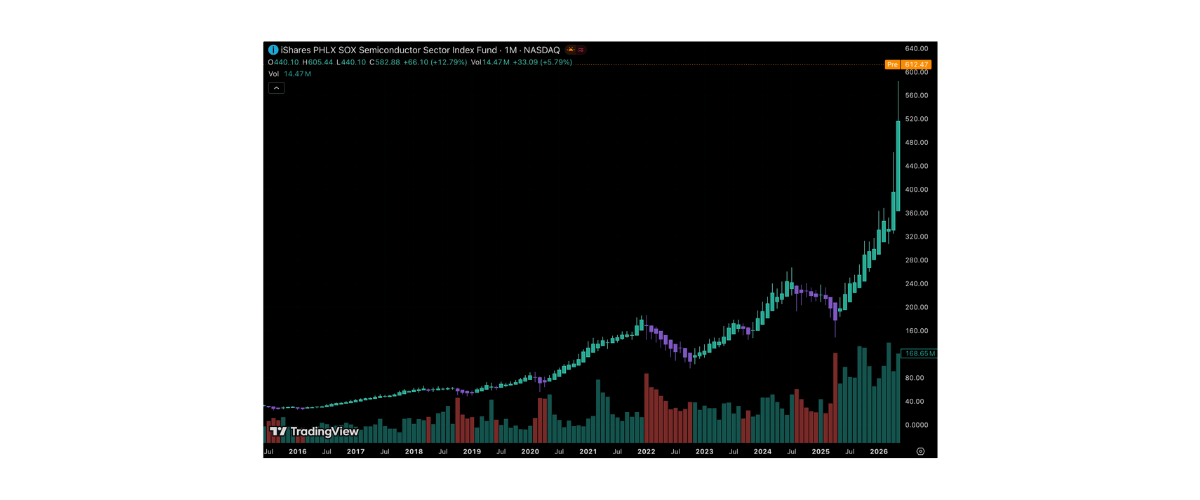
That is why traders often watch the iShares Semiconductor ETF, known as SOXX.
What Is SOXX?
SOXX is a U.S.-listed exchange-traded fund managed by BlackRock. It gives targeted exposure to leading semiconductor companies, a key part of modern electronics, cloud infrastructure, computing, and artificial intelligence.
The fund tracks the NYSE Semiconductor Index, a modified market-cap-weighted index made up of semiconductor designers, manufacturers, and equipment makers. Its holdings include major names such as NVIDIA, Advanced Micro Devices, Broadcom, and Texas Instruments.
As of early 2026, SOXX had around $21.2 billion in net assets, an expense ratio of 0.34%, and 30 U.S.-listed semiconductor stocks. The fund was launched on July 10, 2001, trades on Nasdaq under the ticker SOXX, and distributes income quarterly.
A Focused Semiconductor Trade
The ETF is not broad market exposure. It is a focused semiconductor trade.
That focus can create opportunity when chip demand is strong. It can also increase volatility when sentiment turns.
Performance and Volatility
As of early 2026, SOXX had delivered a one-year total return of about 40%, supported by the 2025 rally in AI-related chip demand. Over the past decade, its annualized return was above 27%. But the fund also carried a three-year standard deviation near 27%, showing how volatile the semiconductor sector can be.
Income and Valuation
Its income profile is limited.
SOXX had a 12-month trailing yield of roughly 0.6% and a price-to-earnings ratio around 43.
Its beta, near 1.6, shows above-market sensitivity.
What Traders Should Know
For traders, the point is simple.
SOXX can be a clean way to track the semiconductor side of the AI narrative. It connects directly to themes like artificial intelligence, cloud computing, digital infrastructure, and data center growth.
But it should not be treated as a defensive holding.
It is better understood as a focused, thematic allocation within a broader portfolio.
A strong narrative can bring SOXX onto a trader’s watchlist.
The setup still matters. And That creates opportunity.
It also creates traps.
When a narrative becomes this powerful, traders can start treating attention as confirmation. A stock is moving, the hashtag is visible, the chart is clean, the story sounds obvious. But obvious stories can still produce crowded trades, sharp reversals, and sudden sector rotation.
Traders should ask three questions before acting on AI headlines:
Is this headline changing fundamentals, sentiment, or both?
Is the move broad across the sector, or concentrated in one name?
Am I trading a setup, or reacting because the story feels important?
That third question is uncomfortable. It is also useful.
The AI trade is likely to remain one of the defining market narratives of 2026. But the best traders will not chase every announcement. They will watch how the market absorbs the news, where volume confirms interest, and where the story starts to run ahead of the chart.
A good narrative can put a market on your screen.
It should not be the only reason you press the button.
FAQ
Why do AI headlines matter to traders?
AI headlines can affect Nasdaq sentiment, semiconductor momentum, software rotation, IPO appetite, and retail trading attention.
Does an AI IPO filing mean AI stocks will rise?
No. IPO activity can support sentiment, but it can also test liquidity, valuation expectations, and investor risk appetite.
How should traders handle crowded narratives?
Use clear setups, defined risk, and confirmation. Avoid trading only because a topic is popular.
Is this investment advice?
No. This is educational commentary about market narratives and trader psychology.
Relevant data points