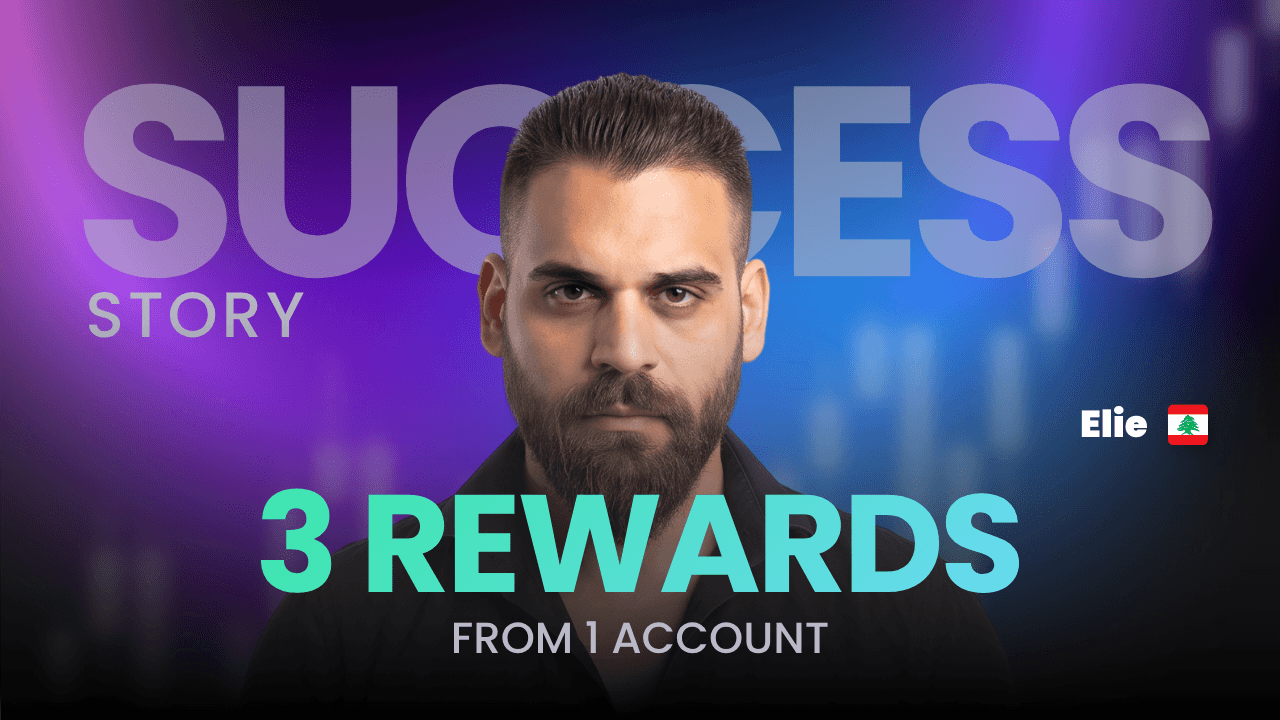
Elie is 30, from Lebanon, and worked as a photographer and in VIP close protection before trading. During Lebanon's economic crisis, salaries fell as low as $40 a month. “I had no room for risk,” Elie says. Prop trading changed that.
The road to a first Reward with The Trading Pit took around three years and plenty of blown accounts. When it finally came, it didn't feel like the finish line. “I had this feeling that this is more responsibility,” Elie says. “Now the work begins.”
Why Prop Trading Made Sense for Elie
With almost no savings to risk, a personal trading account was never a real option. Prop trading offered a different deal: a small Challenge fee in exchange for access to a much larger account, with the risk defined up front.
Elie learned to measure results against that fee, not the account size. A 1% gain on a 10K account is $100, which sounds small. “But that's not my money,” Elie says. If the Challenge cost $100, that same 1% is a 100% return on the money actually spent. Elie closed the interview by thanking The Trading Pit for the opportunity and for being, in Elie's words, an amazing prop firm.
From Skeptic to Trader
Lebanon's economic crisis began around 2019, but Elie didn't start trading until 2022. The extra time went into thinking it over. Elie was skeptical, and most of what turned up online about prop trading was negative.
The first attempt was with personal capital: $500, which turned into a $100 profit. Even so, Elie stopped. “I'm not comfortable,” Elie says. With no financial cushion, trading personal money felt like too much. Moving to prop trading, alongside a full-time job, felt smooth by comparison.
The Trap of Cheap Second Chances
The low cost of a Challenge turned out to be a trap at first. Around $50 for a 5K account, around $100 for a 10K: losing one didn't seem like a big deal. “I could push my luck,” Elie says. “That's exactly what got me always blowing my accounts.”
The change came when Elie started treating each account with respect, as an opportunity rather than a ticket. Once that clicked, the predefined risk became a strength. “It got me feeling that now I can risk manage any amount,” Elie says.
The First Reward
After about three years, everything came together. “One day, everything clicked,” Elie says. The first Reward felt amazing, but it didn't change the strategy. By then Elie already had an approach that worked.
What it did bring was something Elie calls true hope: proof that the process works, and the confidence to build on it.
Losing the Ego
Psychology was Elie's biggest struggle, especially ego. “Honestly, nothing helped me except losing,” Elie says. “It broke me in the financial market.” Trying to fight the market never worked. Now Elie trades the probability of each setup and accepts the outcome: risk is 0.5% per trade, and if the stop loss is hit, the day is over.
The prop firm rules followed the same arc. Daily and maximum drawdown limits used to be frustrating. Today Elie sees them as rules worth keeping even outside a prop firm: risk 1% at most and set a hard limit. “It's non-negotiable,” Elie says. Anyone who later moves profits into a personal account should bring the same risk management along, because that is what got them there.
The Plan: Same 1%, More Accounts
Elie isn't chasing bigger months. The goal is to add more accounts, 10K, 50K, maybe 100K, and copy trade the same approach across all of them. “I don't want more reward from one account,” Elie says. “I want the same reward from many accounts.”
That way, 1% on each account can add up to much more, without taking a single extra risk per trade.
Elie's Advice to Traders
For staying disciplined, Elie's advice is simple: don't stay glued to the screen. Go for a run, go for a walk, and respect what you're working on. “It's an opportunity that not a lot of people can catch,” Elie says.
And the message for a younger self, just starting out four years ago? Focus only on trading, stay determined, and stop listening to everyone else. “Unfollow these people and influencers on social media,” Elie says. “Just focus on yourself.”
Want to hear it directly from Elie?
Watch the full interview below for more on how Elie learned to respect risk and why 1% is all it takes.