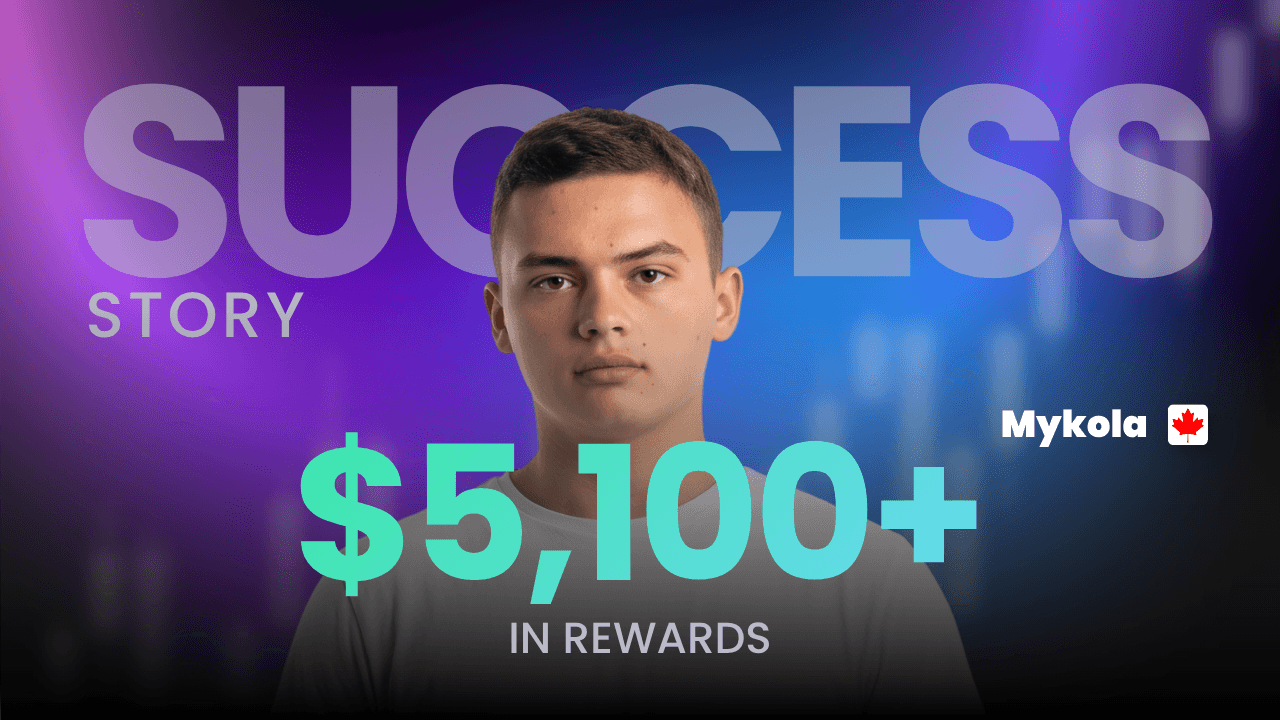
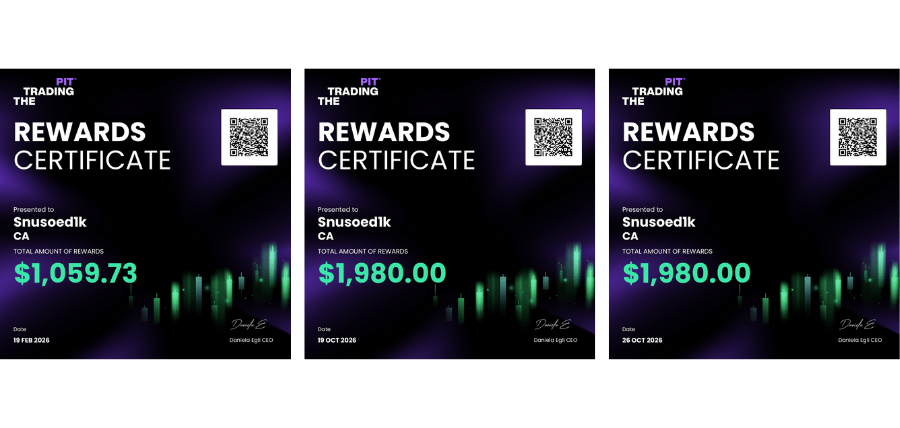
Mykola is 19, originally from Kharkiv, Ukraine, and now trades from Canada. He has earned $5,100 across three Rewards with The Trading Pit. Getting there took almost three years: a liquidation on his first crypto account, several strategies that didn't fit him, and a long fight with his own impulses.
The biggest lesson, he says, had little to do with charts. “The most difficult was dealing with yourself and your emotions.”
Why Futures Prop Trading Works for Mykola
Mykola trades US index futures, the S&P 500 (ES) and the Nasdaq, so a futures Challenge fits his market directly. When traders in his community explained that a futures Challenge could give him a $50,000 account, the idea clicked straight away. “I basically understood the whole system,” he says, “why it works.”
Prop trading also lets him scale without changing how he trades. He keeps a steady 0.5% risk per trade and spreads it across several accounts. The numbers grow, but the rules stay the same.
A Black Swan, a Community, and a Hard Reset
Mykola found trading online and started with technical analysis on crypto. His first account ended in a liquidation during a black swan event. That was when he realised he knew too little. He joined an online trading community, found a mentor in Andrey, and over time went from student to one of the community's mentors himself.
The early years were expensive. In his first year, he admits, he tried to earn money instead of learning how to trade. A few losses would push him to chase them back, and the chase usually ended at the daily loss limit. His worst day came when he lost four accounts in a single trading day, one in each session from Asia to New York. “You sit and feel like an idiot,” he says. “You have the knowledge, but the emotions are stronger.”
By his own count, he went through around 200 Challenges before he fully understood his mistakes.
Finding a System He Could Trust
Mykola moved through several approaches. He traded supply and demand on forex for about six months, then spent more time on Smart Money price action. Neither gave him confidence. “I didn't understand what was going on,” he says.
Timing was part of the problem. From Canada, the London session started at 1 a.m., or 2 a.m. in winter. He would trade through the night, sleep a couple of hours, then wake up for New York. The tiredness showed up in his trades as pointless, impulsive positions.
In October 2025, again through his mentor, he switched to Market Profile and US indices only. He started with the S&P 500 (ES), added the Dow Jones and then the Nasdaq. Since April he has narrowed it to ES and the Nasdaq, the two he finds most technical, and he uses Nvidia as an extra confirmation for Nasdaq entries. His trading window now runs from 7:30 to 9 a.m.
Switching to Prop Trading
Mykola bought his first prop account in June 2024, and the jump in size hit him hard. On his own deposit, a stop loss cost $10 or $20. On a prop account, his first stop felt like his whole deposit. “It prevented you from developing properly,” he says. After a week and a couple of stops, he dropped his risk to 0.5% per trade. That first account lasted about a month before he lost it in Phase 1.
Scaling brought a new kind of pressure. On a $50,000 account at 0.5% risk, a stop costs $250. Across four or five accounts, the same stop becomes $1,250. “These are different emotions and problems,” he says, and he had to learn to handle them.
The Rule That Changed His Trading
For three months, Mykola kept an emotion journal. Every morning he wrote down how he felt when he woke up, then what he felt entering and exiting each trade and what he saw on the chart.
The pattern was clear. On days he woke up in a bad mood, desperate to make money, or still frustrated about a trade that had stopped out and then run to his target, he ended up gambling. So he made a rule: if he wakes up in a bad mood or tired, he doesn't trade. “Otherwise I open unnecessary deals and lose my money,” he says.
What the First Reward Really Meant
Mykola's first Reward was small, and it didn't change his life financially. What it changed was his confidence. “I realized that my system works,” he says. The real milestone came later, once Rewards started arriving regularly, at least once a month. That was when he started to feel calm.
Before trading full-time, he worked in auto disassembly and detailing, with a shift starting at 8 a.m., right in the middle of his trading window. Now he trades from home with no one interrupting him, and he says his decisions have become steadier step by step. “I started to like it more,” he says.
Mykola's Five Steps for New Traders
Pick one market and one system. Trading crypto, forex and indices all at once leaves you with no confidence and a messy process.
Backtest it. Around half a year of backtesting shows whether the system actually works.
Buy your first account and expect to lose it. Most traders he has seen lose their first one, and that is normal. Use it to build risk management that keeps you calm.
Learn to trade, not just to pass. Passing a Challenge is not the same as knowing how to trade.
Read about trading psychology. “We are the same animals looking at the chart,” he says.
He also warns against setting deadlines. Rushing to hit a time limit leads traders to buy or reset account after account. And above all, be honest about whether you want this. Many people he met expected an hour a day to be enough, and they are no longer around. He points to a friend who traded the same account for two and a half years without giving up, simply working toward the result.
Want to hear it directly from Mykola?
Watch the full interview below for more on his journey, his Market Profile approach, and the habits that turned his trading around.