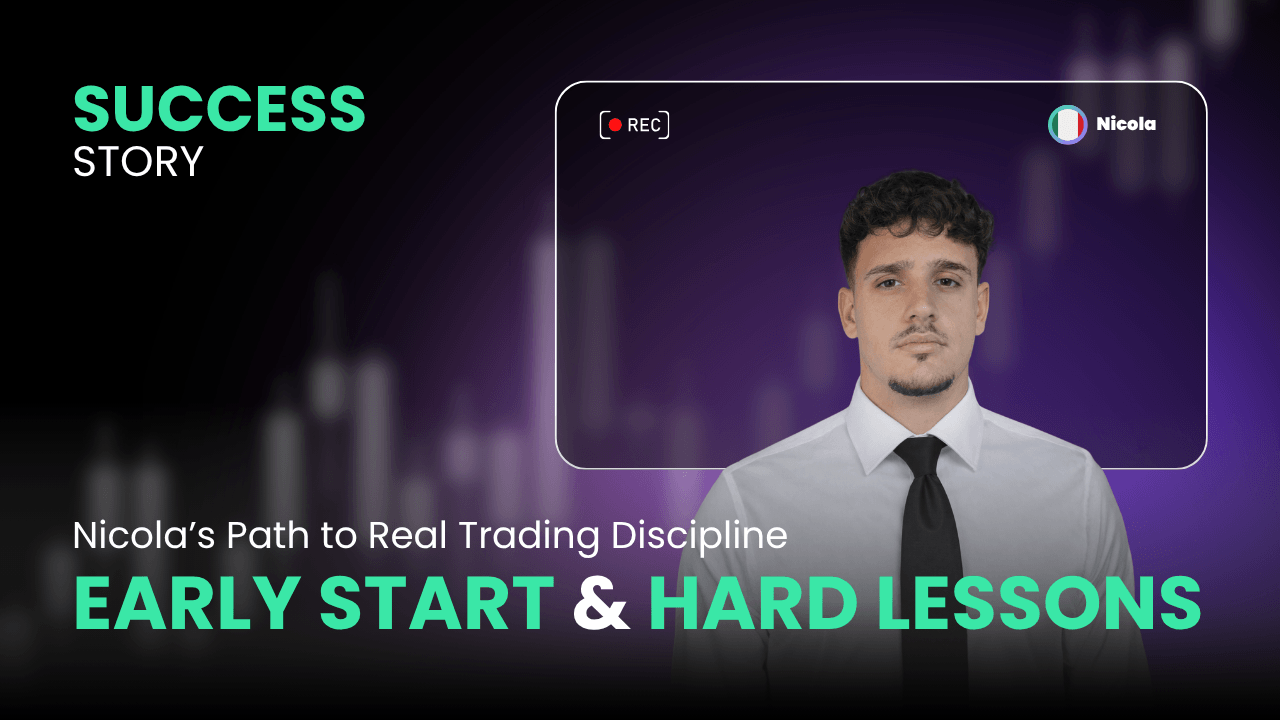
Nicola’s journey into trading didn’t begin with a structured plan or professional ambition. It started with curiosity at a young age and evolved into a disciplined pursuit shaped by mistakes, persistence, and self-awareness.
Early Exposure and First Steps
Nicola discovered financial markets around the age of 13, influenced by exposure at home and growing curiosity. Initially, trading felt distant - something theoretical rather than a realistic path.
At 18, during university, he revisited trading with a more serious mindset. Like many beginners, he encountered misleading information and unrealistic expectations. This phase became a turning point, forcing him to question assumptions and seek a more grounded approach.
The Shift to Structured Learning
Nicola transitioned from casual interest to structured learning through backtesting and strategy development. Early success came quickly - but it brought overconfidence.
Passing his first challenge and achieving initial rewards created the illusion of mastery. That perception was quickly corrected when emotional decisions led to losses.
This phase established a key principle: technical knowledge alone is insufficient without emotional control.
Understanding the Role of Psychology
Over time, Nicola identified emotional patterns - FOMO, revenge trading, and impulsive decisions. Learning to recognize these patterns became a defining factor in his progress.
Instead of forcing trades, he developed the discipline to step away when conditions weren’t aligned. This shift reduced unnecessary losses and improved consistency.
Trading became less about action and more about control.
Scaling Through Funded Accounts
Discovering funded trading changed Nicola’s perspective on capital. It removed the limitation of personal funds and introduced a scalable path.
However, he emphasizes that passing challenges and maintaining consistency are different skills. Scaling required years of refinement, discipline, and emotional stability - not just strategy.
As experience grew, achieving rewards became more routine, driven by consistency rather than excitement.
External Pressure and Independent Thinking
Coming from a non-financial background, Nicola faced skepticism from family and peers. Trading was seen as unrealistic or unreliable.
He chose to ignore external opinions and focus on his own development. This independence became a critical factor in maintaining direction during difficult periods.
The ability to filter external noise remains one of his strongest advantages.
What Trading Provides Today
For Nicola, trading is no longer about quick gains. It represents freedom - control over time, location, and lifestyle.
He emphasizes that trading should be approached as a profession, not a shortcut to wealth. Consistent results come from treating it as a structured process rather than chasing outcomes.
The most important lesson from Nicola’s journey is the ability to stay focused on personal conviction while continuously improving.
Ignoring external noise, managing emotions, and committing to long-term development define his approach today.
Watch the full story here: