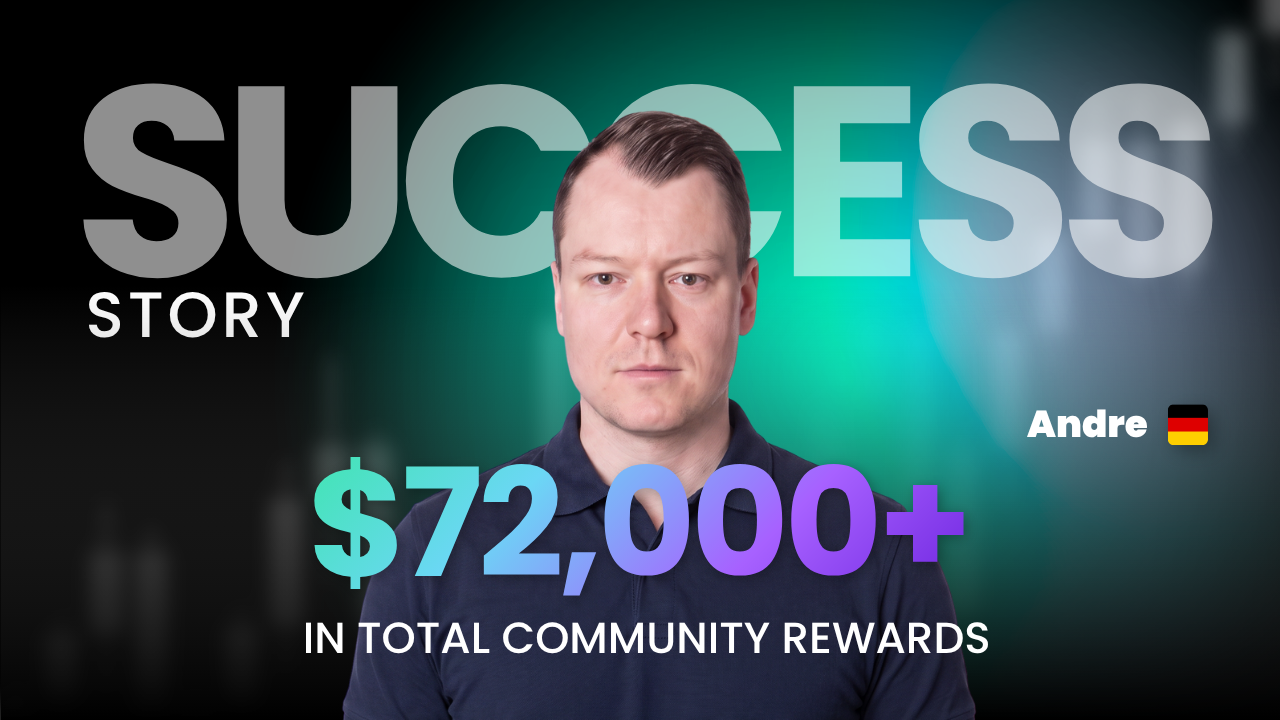
Andre Witzel is a German day trader, coach and the trader behind trading.de, with around 40,000 YouTube subscribers in Germany and a growing English-language audience. Traders in his community have earned over $72,000 in Rewards with The Trading Pit. His own path to a strategy that works took around ten years, much of it, in his words, “years of learning, years of failure.”
The moment that stays with him most came before he even started coaching. A trader messaged him privately to say he had once paid $5,000 for an indicator, then found Andre's free videos, applied the strategy and got his first results.
Why Prop Trading With The Trading Pit Works for His Community
Andre partners with The Trading Pit, and for his students the biggest benefit is capital leverage. A Challenge costs around $200, and in return a trader gets an account that can absorb roughly $6,000 in losses. “If you see what you pay and what you get for it,” he says, the difference is hard to ignore.
He sees a second benefit in the rules themselves. A fixed risk limit stops traders from doubling their size after two losses to win the money back. “It forces you more to apply risk management,” he says.
From a TV Ad to Deleting Everything
Andre's first step into trading came from a TV advertisement. He opened an account, watched five videos, and lost his first money within a week. It wasn't much, but seeing others on YouTube actually make money convinced him to learn properly. With little German-language material available at the time, he turned to English sources and worked with several coaches.
The first year was trial and error. The next five went from strategy to strategy, some of them profitable. One worked but was so complex it led to a small burnout. “It became harder and harder,” he says. “Too many charts, too many indicators.” So he deleted everything and moved to a naked chart, focusing only on price action and market structure.
The Missing Half: Knowing When to Exit
For years Andre studied how to find the best entry. “You don't think about the exit,” he says. Learning where to take profit was the biggest jump in his learning curve. Before that, he had months of good profit followed by losing everything.
Today he plans each trade with a tight stop loss and a target far enough away to make the risk-reward ratio worth it. That means he doesn't need a high win rate. With a high enough ratio, he says, a hit rate of around 30% can still be profitable, which is why he believes the approach suits beginners and Challenge traders too.
From YouTube Videos to a Coaching Community
Andre started coaching only about three years ago. Before that, he simply posted his live trades on YouTube, partly because explaining every step helped him learn faster. The channel grew into a community, and that community now has its own dedicated coaching group within his German project.
The best feedback is simple. “Sometimes we get comments where people write, hey, I just tried it out and it works,” he says. As for those who quit, he says it is rarely because trading is too hard. Most say the style doesn't suit them or they can't fit trading into their lives.
The Strategy: Big Picture First, Then the Colour Switch
Andre trades trends on the one-minute chart, which gives more signals and faster learning than higher timeframes. The first step is always to zoom far out and see several days at once. If the market has been rising for two days, he won't short it. If there's no trend, he doesn't trade.
He keeps his markets simple: EUR/USD in the morning and the S&P 500 in the afternoon and evening, because it tends to run in one direction for hours or days. He avoids DAX futures entirely and would only touch the DAX as a CFD. As a beginner, a sudden spike in thin liquidity stopped him out with a loss of around 3K.
For entries, he watches each candle for a colour switch, a small pullback where a red candle turns green, and places a tight stop just below it. Targets sit at the nearest relevant high or low. He aims for 1:5, sometimes settles for 1:4, and manages aggressively once a trade reaches 1:3, so his average lands around 1:3. In strong trends he also uses an anchored VWAP to spot fair-value pullbacks.
Fewer Trades, Better Trades
The fast one-minute chart makes overtrading easy, so Andre's community follows a hard rule: stop after two losing trades in a day. He rarely takes more than three trades a day, and after one strong runner he often stops. “Experience shows: the fewer trades, the better you trade,” he says. He also keeps a trading journal and reviews it for mistakes and trade count.
The traders who earn Rewards, he says, follow the strategy steps exactly, starting with the bigger picture and a clear trading plan. “If you don't have a target for your trade, don't do it,” he says. A 1:1 setup isn't worth taking when the whole approach relies on a lower hit rate.
Andre's Advice to Traders
For prop traders, his first point is to read the rules and understand them, then adjust risk and money management to fit. Before buying anything, he recommends practising on a demo account.
On strategy, he keeps it to market structure. Learn to read highs and lows, notice when lows keep holding higher because “something is pushing,” and always know where the market can go. “If you don't have it, don't trade it,” he says.
Want to hear it directly from Andre?
Watch the full interview below, including a live walkthrough of his S&P 500 setups and what he calls an A+ trade.